
RIP Marjane Satrapi
The Iranian-French cartoonist and film-maker turned a childhood under revolution into one of the most widely read graphic memoirs ever published.

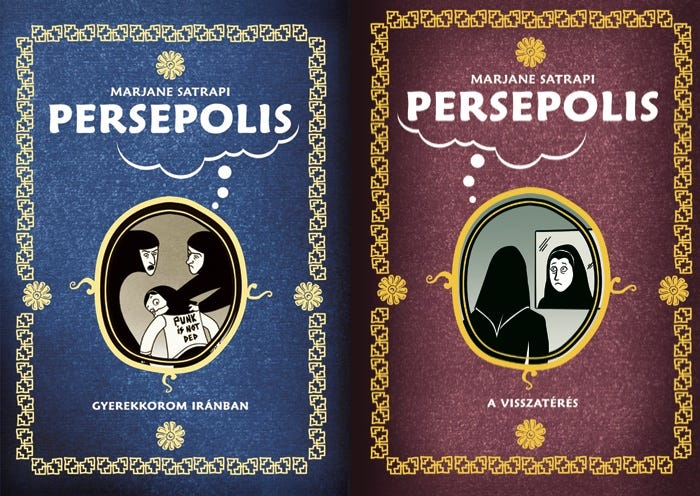
On the opening page of “Persepolis,” a round-faced 10-year-old sits in a black headscarf she has just been ordered to wear, arms folded, glaring out of the panel. The year is 1980, and Iran’s new rulers have decreed that girls must cover their hair at school. The scowling child is Marjane Satrapi, and the book is her own account of growing up as the revolution remade the country around her. She drew it two decades later in plain India ink, black on white, the figures pared down almost to pictograms.
The spareness of the images said little about the woman behind it. Far from austere, Satrapi was exuberant and contrary: she thought a society afraid of every pleasure was a sick one. She smoked through interviews, talking faster than note-takers could follow. “Smoking kills you, but life kills you,” she liked to say.
She kept her drawings plain on purpose: a face built from a few black lines belongs to no nation in particular, so a reader anywhere might recognize a child like their own instead of a foreigner, and find it harder to write off a whole people as strangers.
Her resistance to easy labels had roots in her family. Born on November 22, 1969 in Rasht, on Iran’s Caspian coast, she grew up in Tehran in a household at once grand and radical: by her own account she descended from the Qajar monarchs whom the Pahlavi dynasty had pushed aside, one great-grandfather having ruled Persia for nearly half a century, while her parents kept leftist company and marched against the Shah, then against the clerics who proved worse than he was.
Then the arrests reached people she knew. Her uncle Anoosh, a communist who had spent years as a political prisoner and longer in Soviet exile, was the relative she loved most. When the new regime condemned him, he was allowed one visitor on his last night and asked for her, still a child. He was buried in an unmarked grave. History, she came to think, was not a theory but a list of people one had known by name.
At 14 her parents sent her to Vienna alone, reasoning that exile was less dangerous than the trouble she courted at home, where she argued with the morality police and bought banned music. But Vienna treated her badly: she moved between lodgings, slept on friends’ floors, spent a spell on the street, and nearly died of bronchitis before going home. In Tehran she had been ordered to cover; in Vienna she learned that Europe had its own firm idea of what she should be. To many of the Europeans she met, a girl from Iran was either a victim to be pitied or a curiosity to be quizzed about veils and ayatollahs, and she had no patience for being either. Back in Iran she took a degree in visual communication, married a veteran of the war with Iraq at twenty-one, and divorced him. Her parents told her the country no longer had room for her, so she went to Strasbourg, then Paris.
“Persepolis” appeared in France in four volumes between 2000 and 2003, brought out by the small collective L’Association and drawn entirely in black and white. It reached readers well beyond the comic-book shelves, partly because it skipped the outsider’s tour of Iran and just showed a girl growing up there, as bored and rebellious as any adolescent anywhere. (A Chicago school district later tried to pull it from classrooms over its language and violence; the attempt only sent more readers to it.) Satrapi had no patience for the dignified label such books attract. The phrase “graphic novel,” she said, had been coined so that respectable people could read comics without embarrassment.
With the artist Vincent Paronnaud she made the book into an animated film, keeping the ink and the plainness of the page. It shared the Jury Prize at the Cannes festival in 2007 and was nominated for the Academy Award for best animated feature, the first time a woman had been named in the category. The theocrats in Tehran were not pleased, and the Iranian regime arranged for the film to be dropped from a festival in Bangkok.
Satrapi turned to film and stayed there. “Chicken with Plums,” again with Paronnaud, came in 2011, followed by a crime comedy in which she also acted. English-language work followed: “The Voices”(2014), a horror farce with Ryan Reynolds as a man advised by his pets, and “Radioactive” (2019), a life of Marie Curie starring Rosamund Pike. Studios, she said, gave women small budgets and kept the big ones for men. Her last film, “Dear Paris” (2024), was an ensemble comedy about Parisians colliding with death. She had wanted to be more than the woman who wrote “Persepolis.”
After 2022 Satrapi stopped resisting the pull of the book. When Mahsa Amini died in the custody of Iran’s morality police and protests spread under the banner “Woman, Life, Freedom,” she gathered other artists into a collective graphic volume meant to carry the uprising to readers abroad. In 2024 Spain awarded her the Princess of Asturias prize for communication and the humanities. The following January, France offered her the Légion d’honneur, its highest decoration; she turned it down, objecting to what she called French hypocrisy toward Iran while insisting the refusal was no insult to a country she loved as her own.
Mattias Ripa, the Swedish producer she had married, died in April 2025. This morning, a little more than a year later, she joined him. She had spent her life insisting that the world is not drawn in two colors, and that the real divide is between cruel people and kind ones, wherever they live. Her family announced she had died of “sadness” — the sort of cause a coroner does not record but an artist might. Marjane Satrapi would not have permitted her end to be portrayed in monochrome.
What a thoughtful and moving tribute, Bobby. We’re all the poorer for her loss.
The last words of The Complete Persepolis are, "Freedom had a price." Rest in peace. And thanks for this tribute.