
He Thereby Declared
The Founders proclaimed America’s independence 250 years ago. An Indian barber in Virginia beat them to it by seven weeks.


“RUN away… a Servant Man named John Newton, about 20 Years of Age, 5 Feet 5 or 6 Inches high, slender made, is an Asiatic Indian by Birth.” — The Virginia Gazette, July 13, 1776
Nine days after the Continental Congress renounced a king, a newspaper in Williamsburg, Virginia, offered eight dollars for the return of a young man who had renounced his master.
The advertisement — placed by one William Brown of Prince William County, highlighted in our own century by the journalist Francis C. Assisi and preserved in the University of Virginia’s Geography of Slavery database — is a portrait composed by a hostile witness, and it is very nearly everything history knows of its subject. John Newton wore his long black hair tied behind and pinned up at the sides, in the fashion of the day. He had, Brown noted, “a very sour Look.” (One struggles to imagine why.) He was dressed in a worn beaver hat, a postilion’s riding coat, country-made shoes, and on them a pair of buckles in pinchbeck — a copper alloy that does a passable imitation of gold. He was a trained barber and hairdresser.
And he had been gone for two months.
Newton had slipped away in the second week of May, on the road running north out of Williamsburg, somewhere between King William Courthouse and Todd’s Bridge. He had been left behind, the ad explains, to follow slowly with a tired horse. The horse died, and Newton disappeared.
Now consider what was happening in the town behind him. On May 15, 1776, the Fifth Virginia Convention, sitting in Williamsburg, voted unanimously to instruct Virginia’s delegates in Philadelphia to propose independence from Britain. On June 12, it adopted George Mason’s Declaration of Rights, which opens by asserting that all men are “by nature equally free and independent.” In July, the town’s presses printed the Declaration of Independence — the same presses, in the same weeks, that set the type for the hunt for John Newton.
The advertisement supplies his biography in shorthand. He was born in India around 1756. He had been in Virginia about twelve months, “but lived ten Years (as he says) in England, in the Service of Sir Charles Whitworth” — a member of Parliament and chairman of the Commons’ committee of Ways and Means; the bookkeeper, in effect, of the British Empire. Note the parenthesis. “(As he says)” is the only place in the record where Newton gets to speak, and even there he arrives pre-doubted, his own life flagged as unverifiable goods.
Historians of the Indian presence in Georgian Britain, notably Michael Fisher and Rozina Visram, have documented the pattern he fits: boys carried away from India by East India Company men, baptized into sturdy English names, kept in grand houses as living ornaments. Around 1775, somebody shipped this particular ornament to Virginia. In a single year there, he passed through at least three pairs of hands — a Mr. Rootes of Frederick County; a Colonel Blackburn of Prince William, almost certainly Thomas Blackburn of Rippon Lodge, delegate to Virginia’s revolutionary conventions and later an aide to George Washington; and finally Brown, who put his value at eight dollars.
And then raised it. Six days after the first notice, Brown advertised again in a rival paper — Williamsburg had three, all confusingly titled the Virginia Gazette — now offering ten dollars and adding that Newton “shaves and dresses well, but is much addicted to liquor.” The “Asiatic Indian” of July 13 had become, by July 19, “a mulatto servant man, named John Newton… an Indian by birth.”
People from the subcontinent had been in the Chesapeake for well over a century by then. The earliest on record is “Tony, East Indian,” listed as human collateral in a 1635 Virginia land claim — the seed of Brinda Charry’s fine 2023 novel, The East Indian. Colonial law never worked out what such people were. One Virginia court, asked to classify the child of an East Indian, gave up: the statute “only relates to Negroes and Mullatoes and being Silent as to Indians.” Into that silence, most of them disappeared — relabeled mulatto, then negro, then colored, their descendants absorbed into Black America, the Indian origin forgotten within a generation. The genealogist Paul Heinegg has spent decades tracing such families through the paperwork of their erasure.
These days, I can check a box marked “Asian Indian” on American forms; the census only got around to printing that box in 1980. The printers of Williamsburg had no box for John Newton.
Where was he going? Not, it seems, to the British. Lord Dunmore, Virginia’s ousted royal governor, had promised freedom to any rebel-owned slave who reached his lines, but by that summer his refuge was collapsing, and in August he sailed away for good. Brown’s advertisement makes a shrewder guess at the plan: Newton was “a good Barber and Hair-Dresser,” and “it is probable he may endeavour to follow those Occupations as a free Man.” It is a tantalizing thought: A man whose trade was making Virginia’s gentlemen presentable proposed to make himself invisible — to walk into a town where nobody knew him and shave free men for money until he became one.
After July 19, 1776, the record falls silent. No capture notice, no jail entry, no grave. On most days, honesty obliges a writer to concede that silence, in a slave society, usually meant a bad end. Today is not most days. On the country’s 250th birthday I will claim a citizen’s privilege and read the silence the other way: somewhere in the din of the new republic, a slender man with pinned-up hair and imitation-gold buckles, answering to another name, strops a razor.
Free.
Next week, and in the weeks thereafter, courthouses across America will swear in thousands of new citizens, as one in downtown Manhattan swore me in in 2013. The oath begins: “I hereby declare, on oath, that I absolutely and entirely renounce and abjure all allegiance and fidelity to any foreign prince, potentate, state, or sovereignty.” Note the verb: Becoming American is, as much as anything, an act of renunciation. The men in Philadelphia renounced a prince, on parchment, and were called Founders. I renounced the state in which I was born, and was handed a certificate. John Newton renounced a “master” — a category the oath’s drafters never thought to list — and got, for his trouble, a price on his head that rose two dollars in a week.
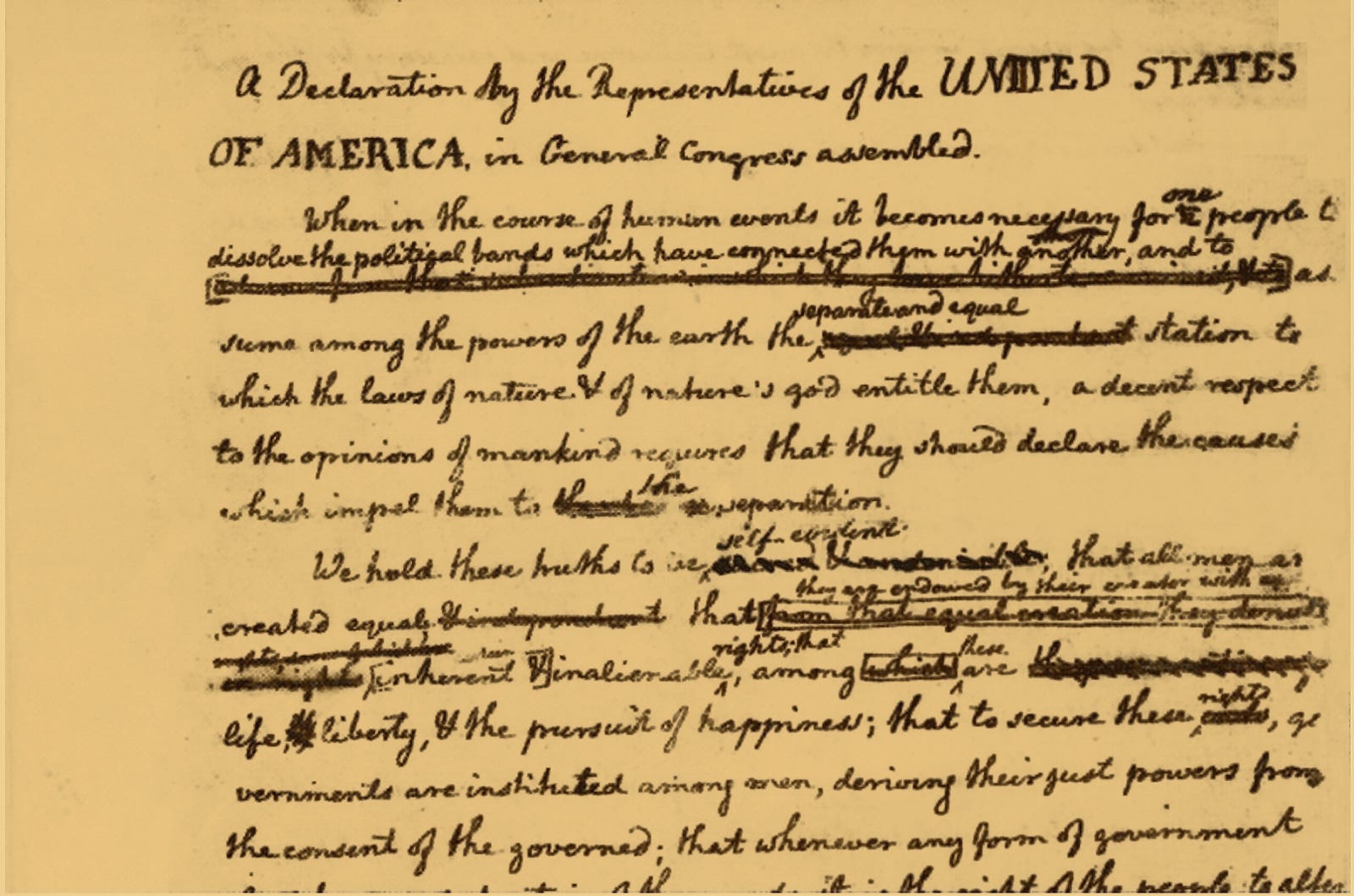
He performed America’s founding act seven weeks before the Founders. No parchment, no signatures, no committee of five. His declaration was made on foot, on the road out of Williamsburg, and the only copy that survives is the advertisement demanding he take it back.
I hope he never did.
Pitch-perfect, as always. This is a good day to remember the power of renunciation.
One of your best. My compliments.